
Between work, family, creativity, and sports, time never seems to be enough. Yet for some people, passions are not an “extra,” but an essential part of everyday balance.
At SORINT, this has a concrete meaning: attention to people and their personal lives translates into the ability to balance work and passions, creating space where professional growth and personal fulfillment can coexist.
In this interview, we meet Susanna Cenati, a SORINTian who has managed to combine different career paths, family life, and a strong passion for climbing, eventually entering the world of competitive paraclimbing and earning a place on the national team.
A story of change, fresh starts, and discovery, where sport becomes a way to better understand yourself and grow, both inside and outside of work.
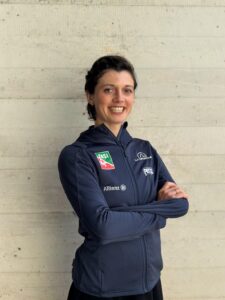 Q: Hi Susanna, let’s start with you: who are you, both inside and outside of work?
Hi! 😊
I’ve been working at SORINT for 10 years (11 this year). During this time, I’ve had the opportunity to grow and take on different roles. I started by supporting PMO back-office activities, then moved into visual interface work in UX/UI, and later began a new path by joining the marketing team.
Today, I mainly focus on graphic design and video making/editing.
In my personal life, I’m a wife and the mother of a nearly 3-year-old daughter.
Q: What do you like to do in your free time?
I have several hobbies that I love, mainly divided into two areas: art and sports. As you can imagine, this means constantly balancing work, family, and personal time, a challenge shared by many parents.
On the artistic side, I enjoy drawing, painting, and creating objects in clay.
As for sports, I practiced dance for many years. As an adult, together with my husband, I got into trekking and outdoor sports, becoming true “mountain lovers.” What started as a way to spend free time gradually became something more structured: we joined CAI (Italian Alpine Club – Bergamo), becoming section instructors. From there, we got closer to mountaineering and climbing, which has now become my main sport.
Q: How did you get into competitive climbing and paraclimbing?
 It all started quite unexpectedly.
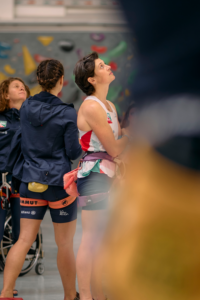
One evening, while scrolling on Instagram, I came across the profile of a girl like me, missing a forearm, who was practicing climbing at a competitive level. I was immediately struck and inspired.
I didn’t realize that people with disabilities could compete in sports at that level. At first, I compared it to “traditional” sports, which I saw as more rigid and structured, with age categories, rankings, and years of required experience.
Still, I decided to reach out to her out of curiosity, and I discovered a completely new world.
She immediately encouraged me to try, but I was hesitant, I was afraid I wouldn’t be good enough.
In 2022, she invited me to an open day. That’s when I truly fell in love with this discipline. I also discovered the world of competitions, especially the national team environment, which really intrigued me: the focus is not only on performance, but also on inclusion and giving opportunities to all athletes.
From that moment on, I decided to start a serious training path with a coach. Shortly after, however, I became pregnant and had to put everything on hold.
Q: How did you get back into it after pregnancy, and what has your journey been like so far?
I never completely stopped. I kept training at the gym, and about a year after giving birth, I returned to climbing in a more structured way.
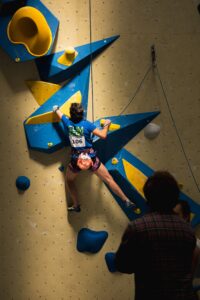 In July 2024, I took part in my first competition in Verona.
It was a very positive experience: I felt welcomed, part of a group, and immersed in a healthy and motivating environment. I was surrounded by people with experiences similar to mine, who truly understood me. It felt natural to share emotions, challenges, and even insecurities. I immediately felt a strong sense of belonging, which motivated me to keep going.
In 2025, I started my first Italian Cup season, made up of three stages. It was a more challenging year: I faced difficult moments and disappointing results, to the point where I even thought about quitting.
Over time, though, what really changed was my mental approach to the sport. This shift was noticed by others as well. When I had to stop again for family reasons, the team kept encouraging me to come back.
And I did: in 2026 I returned with a new season, much more positive than the previous one.
Today I train more consistently: once a week with a coach at ClimBerg ASD in Bergamo and once on my own during my lunch break (and I also have to thank SORINT for that).
How is it going? Very well: I won a silver medal in the first stage and a bronze in the second… let’s see how the next one goes!
Q: I heard you’re now joining the national team, did you expect that?
No, I didn’t… it was a dream.
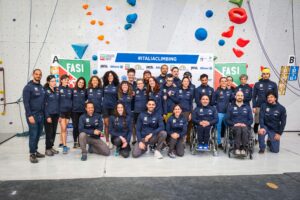
The silver medal I earned in the first stage of the Italian Cup allowed me to join the national paraclimbing team. This means I’ll compete at the World Championships, at least in the second stage in Innsbruck.
This achievement dates back to 2022, to the day of that open day. Since then, it has become a goal built step by step, with consistency, effort, and determination. And today, I finally get to live it.
Q: Earlier you mentioned SORINT. What role does it play in balancing your personal and sporting life?
We talked about how challenging it can be to balance work, family, and personal time.
For me, SORINT has played a key role in making this balance possible, especially thanks to three main aspects:
- Smart working: it allows me to better manage my family, especially my daughter when she’s home from daycare or not feeling well. It also gives me more flexibility in handling daily unexpected situations.
- Flexible working hours: I often train during my lunch break, organizing my work to make up the time later. This allows me to maintain continuity without sacrificing time with my family in the evening.
- Team collaboration: work is organized to ensure mutual coverage. There’s a strong sense of support and understanding, which makes managing unexpected situations much easier. Knowing you can rely on your team creates a positive and collaborative environment.
Q: What has sport taught you that you also apply at work?
Sport helps me clear my mind. It allows me to fully disconnect and then come back more focused and calm. It’s a real outlet.
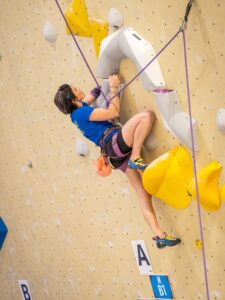 It teaches me concentration: when I climb, I have to be fully focused on what I’m doing. This carries over into my work, where I’m able to stay focused on my tasks.
It also teaches me adaptability: finding different solutions when conditions aren’t ideal.
This applies both in the mountains and at work. In climbing, for example, I often face routes that aren’t designed for someone like me, without a forearm. I have to adapt quickly and find a solution on the spot.
The same happened at work: when I joined the marketing team, I had to quickly adapt to a new environment, new tasks, and new skills. I had no experience in video making or editing, but I had to learn fast to meet the team’s needs.
Sport is also teaching me consistency and discipline: continuous training, commitment, organization, and precision. I’m still working on this… It’s an ongoing process.
Finally, there’s pressure management: especially in competitions, where staying calm and managing anxiety and emotions is crucial. It’s something I’m still developing, but I’m making progress.
At the core of everything, there are positivity and humility. I’m a normal person with a normal life, and I try to face every challenge with a smile.
 Q: What advice would you give to those reading your story?
Sport has taught me that many limits are mental and that we are often the ones creating them.
That’s why I believe it’s essential to always try, without letting fear hold you back. You need the courage to start, even without certainty.And if something doesn’t work out, that’s okay: you adjust, learn, grow, and try again.
Because every attempt, even the ones that don’t go as planned, is still a step forward.
Q: Thank you, Susanna, for your time and for sharing your story with us! 😊