
In an era where AI generates code and content at the speed of light, pausing to “think together” is the only competitive advantage we have left.
The “Infinite Reunion” Paradox: Beyond Mental Drainage
I know what you’re thinking when you see an invitation for a “4-Hour Workshop” pop up on your calendar. The instinctive reaction of a technical profile is often: “Here’s another interminable meeting that could have been an email. When will I find the time to work?”
As the Lead of the Human Centered Design team, I’m here to dispel a dangerous myth:
“A workshop isn’t a long meeting. If it felt that way in the past, it was probably poorly designed.”
Today I want to explain the technical and functional difference between the two, and why, paradoxically, the advent of Artificial Intelligence makes workshops the most valuable tool for our technology and decision-making stack.
Meeting vs. Workshop: A Strategic Distinction
Confusing these two tools is a costly mistake in terms of focus and results. For us on the Human-Centered Design (HCD) team, the distinction is clear and must be made across the entire organization. Below is a source from the Nngroup **that explains the key principles.
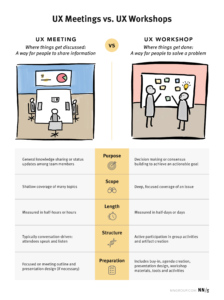
- The Meeting: It’s an exchange of data packets. It’s used to share information, provide status updates, or synchronize teams. It’s often passive: people listen, nod, and absorb.
- The Workshop: It’s a processing environment. It’s where “things get done.” We don’t just talk; we solve problems, generate ideas, and produce tangible, actionable output.
“The workshop isn’t a longer meeting. It’s an artisanal laboratory where we don’t just “talk about work,” but actually do the work. It’s a protected space where ideas aren’t just whispered, but treated like raw materials to be shaped. In this laboratory, we don’t “talk about work”: we do the work. We move from passive information to the collective creation of tangible artifacts.”
Neutralizing the “Biggest Voice”: The Power of Facilitation
In traditional meetings, the one who shouts loudest or sits highest in the hierarchy often wins. This kills innovation and alienates talent. The workshop disrupts this unbalanced dynamic through the role of a neutral facilitator. The facilitator doesn’t get involved in your technical disputes; their job is to protect the process. Neutral facilitation ensures that collective intelligence isn’t stifled by individual biases. The benefits are immediate:
- Shared Ownership: When a solution emerges from a workshop, it’s not “the boss’s decision,” but a product the entire team feels ownership of. This dramatically reduces friction during the delivery phase.
- Evidence-based decisions: Decisions are based on data and the results of practical activities, not on last-minute subjective feelings.
This “harnessing of collective intelligence” allows us to solve complex problems that no single individual (or algorithm) could solve alone.
The discipline of “Doing”: diverge-and-converge
A workshop isn’t a chaotic brainstorming session, but a rigorous discipline that follows the Divergence and Convergence cycle. It’s a structured process designed to prevent premature consensus and force exploration.
- Divergence: Generate critical mass. In this phase, we unleash the possibilities. We use techniques like Silent Writing: we force each participant to write down their ideas independently before sharing them. Why? Because silence is the most powerful tool for ensuring every voice is heard, neutralizing the influence of those who tend to dominate the conversation. With the help of AI, we can also create quick prototypes if writing isn’t enough.
- Convergence: synthesize and decide. Once the raw material is produced, we need to refine it. We don’t use endless discussions, but prioritization tools like Dot Voting (weighted voting) or impact/effort matrices.
“In a workshop, you always leave with a clear direction: either you decide to proceed with a specific action, or you consciously decide to discard an idea. “We’ll talk about it again” is not an acceptable outcome.”
The Age of AI: Reflection as a Competitive Advantage
Today, Artificial Intelligence makes execution rapid and, ultimately, almost free. The risk for a consulting firm is falling into “compulsive doing”: rushing in the wrong direction.
As AI automates production, the workshop becomes our last true, non-automatable competitive advantage. It’s the sacred space for collective reflection and human strategy, where human and artificial intelligence work in synergy: while models execute processes, humans oversee their effectiveness and consistency.
“Speed is nothing without critical thinking. Participating in a workshop means stopping running in vain and starting to design intelligently. Those who use AI as an ally, while remaining at the heart of strategic decisions, don’t just keep pace with the future: they define it.”
Garbage In, Garbage Out: The Preparation
To ensure a workshop isn’t a waste of time, it must adhere to specific rules. A workshop requires much more preparation than a meeting. If I invite you to a workshop, know that the agenda has been carefully designed to ensure every minute is productive. If there isn’t a defined objective (an “actionable goal”), it’s not a workshop, it’s just talk.
The HCD Team can be the facilitator you are looking for your workshops
Within the Human-Centered Design team, we have experienced facilitators ready to empower your teams using proven methodologies (Nielsen Norman Group). Here’s how we can collaborate to transform your challenges into results through specific workshops:
- Discovery Workshops: To align stakeholders and understand the current state of a complex project.
- Empathy Workshops: To build a deep understanding of our users’ needs before writing a single line of code.
- Design Workshops: To quickly generate a wide range of solutions from different perspectives.
- Prioritization Workshops: Deciding what’s truly important when everything seems urgent.
- Critique Workshops: To collectively analyze and improve an ongoing project, ensuring it meets its objectives.
“We provide agenda design, neutral moderation, and output synthesis to transform your time into tangible value.”
A Call to Collaborative Revolution
At SORINT, time is our most precious resource. Honoring it doesn’t mean filling our calendars with meetings but having the courage to demand collaborative moments that produce a real impact.
Time doesn’t go back. Let’s use it to build, not to argue endlessly. We invite you to challenge the status quo: if you have a complex problem, a strategic decision, or a seemingly insurmountable technical challenge, don’t send yet another meeting invitation.
The next time you see that invitation on your calendar, don’t think of it as an interruption in your work. Think of it as the moment we shift from “blind execution” mode to “strategic decision” mode.
The workshop is the tool that allows us to make shared, rapid, and validated decisions, avoiding wasting entire sprints developing products no one wants. In a fast-paced, automated world, the ability to stop and think together is the real killer app.
Conclusion
By actively listening to your users, business, and the team, we create human-centered software design solutions that drive meaningful digital transformation and deliver experiences with a truly lasting impact for everyone.
User Research, UX/UI/ Design, Design Thinking, and more https://www.sorint.com/en/services/hcd/